
Cross Sections | May 2026
Near Death NASA, Ewok Mocumentaries, Jesus at Home Depot, and More!

It’s time for the monthly summary of all most of the places I saw grace, law, gospel, and everything in between…in the month of May. Enjoy!
At the Intersection of ‘Near Death’ and NASA

I stumbled across an article last month about Ingrid Honkala, a marine scientist who says she’s had three near-death experiences over the course of her life. In each one, she describes the same thing: leaving her body, an overwhelming sense of peace, and an awareness of reality that felt deeper and larger than ordinary consciousness.
I’m less interested in proving or disproving stories like this than I am in sitting with the questions they raise. Are these simply the brain’s final fireworks under stress? Or are they glimpses through a window we don’t usually know is there?
Either way, accounts like hers remind me how thin the veil can feel between what we can measure and what we can only wonder about. Science can describe a great deal. But mystery still refuses eviction.
Maybe that’s part of being human: living between explanation and awe, and learning to honor both.
*You can read the full piece here.
Return of the Ewok
Full disclosure: I stumbled across Return of the Ewok last month and had somehow never heard of it. Evidently it came out a year before Return of the Jedi and plays like a mockumentary starring a very young Warwick Davis on his journey to becoming Wicket.
So….how did I find this, you ask?
Like most discoveries worth making: completely by accident.
I’m flipping channels one night and land on Leprechaun in the Hood 2. Absolutely terrible, yet deeply campy and impossible to ignore. I lingered partly because my wife once told me about someone bringing a VHS copy of the original Leprechaun in the Hood to a youth group lock-in at her childhood church - like, what was he thinking? But, I digress…
While I’m engrossed in B-movie urban horror, I start looking up the credits and realize Warwick Davis plays the Leprechaun. Not just in that one, but all the way back through the franchise. Which sends me to Warwick Davis’s filmography. Which reminds me he was in Return of the Jedi and Willow. Which somehow leads me to Return of the Ewok.
The whole thing ended up being far more entertaining than this month’s official Star Wars offering, Mandalorian and Grogu, which, in my opinion, was some trash. The only redeeming moments were seeing Sigourney Weaver piloting an X-wing and the unexpected Martin Scorsese cameo. Beyond that, I was thoroughly underwhelmed.
Meanwhile, Return of the Ewok, a bizarre little faux-documentary from 1982 that I discovered via Leprechaun in the Hood 2, somehow delivered more joy. The full film is available below…
Grace on The PBS Newshour

For years, PBS NewsHour has been part of my evening routine. First as childhood background noise when MacNeil/Lehrer played in the house, later as a way of keeping up with the world, and now as a near-nightly ritual: clearing the room, grabbing something cold to drink, and tuning in, especially on Friday nights.
I’ll admit, not every segment gets my undivided attention. Some become soundtrack to email, dishes, or late-night scrolling.
That was the case this week during an interview with Daniel Lischinsky, whose son Yaron was killed last year outside the Capital Jewish Museum in Washington. The conversation was unfolding in the background while I half-listened and multitasked, until the closing exchange (with interviewer, Nick Schifrin) made me stop cold.
NICK SCHIFRIN: For Jews, memory carries responsibility.
And so how will you not only remember, but honor your son’s legacy?
DANIEL LISCHINSKY: We are publishing a book with his pictures.
Personally, I want to engage also in speaking in churches against antisemitism.
So I will dedicate part of my life also to that in memory of Yaron to try to -- he was a peacemaker.
He was a person bringing people together.
I would like to -- in that way, also to bring people together to try to teach about Israel and against antisemitism.
NICK SCHIFRIN: You have brought, if I may say, grace and compassion to this moment of your grief.
How do you think you have maintained that grace and compassion, despite what you have been through?
DANIEL LISCHINSKY: We know that the grace and compassion comes from God, comes from above.
So we try to be ambassadors of him in this earth and to try to be compassionate with other people.
We -- to try.
It’s not easy.
We are human beings.
And -- but if we get grace and compassion from God, we can give to others.
There was nothing polished or performative about it. Just a grieving father speaking plainly from the middle of sorrow. And maybe that’s why it landed so hard. Compassion, in his telling, is not something we generate from our own reserves. It is received. Given to us by God in our grief, and then, somehow, extended outward to others.
A hard and beautiful reminder for May: grace doesn’t erase suffering. But it can keep suffering from having the final word.
*The full interview is available here.
There’s Always Something Left to Love…

Last month, I caught a local production of Lorraine Hansberry’s classic, A Raisin in the Sun. And yes, the actor portraying Walter Lee truly channeled Sidney Poitier’s essence! The scene in the clip below is hands down my favorite moment in the entire play - it’s the moment Mama confronts Beneatha after she has discarded her brother for losing much of the family’s inheritance. I have recently noticed the juxtaposition between this confrontational scene versus an earlier moment, where Mama reminds Beneatha, "In my mother's house there is still God...". In this scene, the lecture is followed by a slap - while in the clip below, we see the lecture followed by an embrace. Rewatching this clip reminded me of the Judgment/Grace dynamic I had missed in previous viewings.
Here’s a snippet of the dialog for your convenience (the clip is also included below):
BENEATHA
He’s no brother of mine.
MAMA
What you say?
BENEATHA
I said that that individual in that room is no
brother of mine.
MAMA
That’s what I thought you said. You feeling like
you better than he is today? (BENEATHA does not answer) Yes? What you tell him a minute ago? That he wasn’t a man? Yes? You give him up for me? You done wrote his epitaph too like the rest of the world? Well, who give you the privilege?
BENEATHA
Be on my side for once! You saw what he just did, Mama! You saw him down on his knees. Wasn’t it you who taught me to despise any man who would do that? Do what he’s going to do?
MAMA
Yes I taught you that. Me and your daddy. But I thought I taught you something else too ... I thought I taught you to love him.
BENEATHA
Love him? There is nothing left to love.
MAMA
There is always something left to love. And if you ain’t learned that, you ain’t learned nothing. Have you cried for that boy today? I don’t mean for yourself and for the family ‘cause we lost the money. I mean for him: what he been through and what it done to him. Child, when do you think is the time to love somebody the most? When they done good and made things easy for everybody? Well then, you ain’t through learning because that ain’t the time at all. It’s when he’s at his lowest and can’t believe in hisself ‘cause the world done whipped him so! When you starts measuring somebody, measure him right, child, measure him right. Make sure you done taken into account what hills and valleys he come through before he got to wherever he is.
Apple Watch Righteousness
I guess the new Apple Watch has the answer to the competing voices of “law” that confront us daily… as it concerns optimizing our health and fitness. The commercial below is brilliant, except for its conclusion, of course, that tech is the answer. Still, it’s a great diagnostic of law-in-life!
*Btw, I’m an Android user to the day I die…but not this kind of android…yikes!
Jesus and Home Depot

As you can see from the pic above, my local hardware store now has more than mere tools to sanctify the home. Notice this wasn’t found at Lowe’s where you ‘never stop improving’. Btw, looks like Jesus is getting a sequel on Ascension Day, 2028 (courtesy of Mel Gibson). Read more about it here.
Quiet Grief in Adult Friendships
Here’s another recommendation from our dear friend and faithful supporter, Andre Malone! A recent op-ed from Pranav Jain in Times of India unpacks the dynamics of grieving the disappearance of normal adult friendships - noting that nearly every other type of relationship seems to have a unique ritual of mourning. Jain traces a deep connection between the increasing digitization of our world and the correlating difficulty of maintaining healthy grownup relationships. This section of the article gets to the heart of the issue,
Modern adulthood encourages optimization in almost every sphere. Be productive. Be efficient. Heal yourself. Monetize your hobbies. Curate your identity.
Somewhere along the way, friendships too began absorbing the language of management. We now discuss emotional bandwidth like data plans. Even affection sometimes feels evaluated through invisible cost-benefit analysis: Who texts first? Who makes more effort? Who is emotionally available? Who drains energy?
Friendship, however, has always depended on a certain irrational generosity. A willingness to waste time together magnificently. To listen to the same anxiety for the fifth time. To sit through silence. To remain available without agenda.
And perhaps this is why adult friendship feels increasingly radical. It resists the transactional logic modern life rewards everywhere else. Because a real friend offers something profoundly rare: unoptimized presence. Family is structured by blood. Marriage by institution. Work relationships by utility. Friendship survives purely through mutual choosing. Nobody has to stay. And yet some people do.
‘A certain irrational generosity’…now, where have I heard that concept before?
*The full article is available here.
Preparing for Disclosure
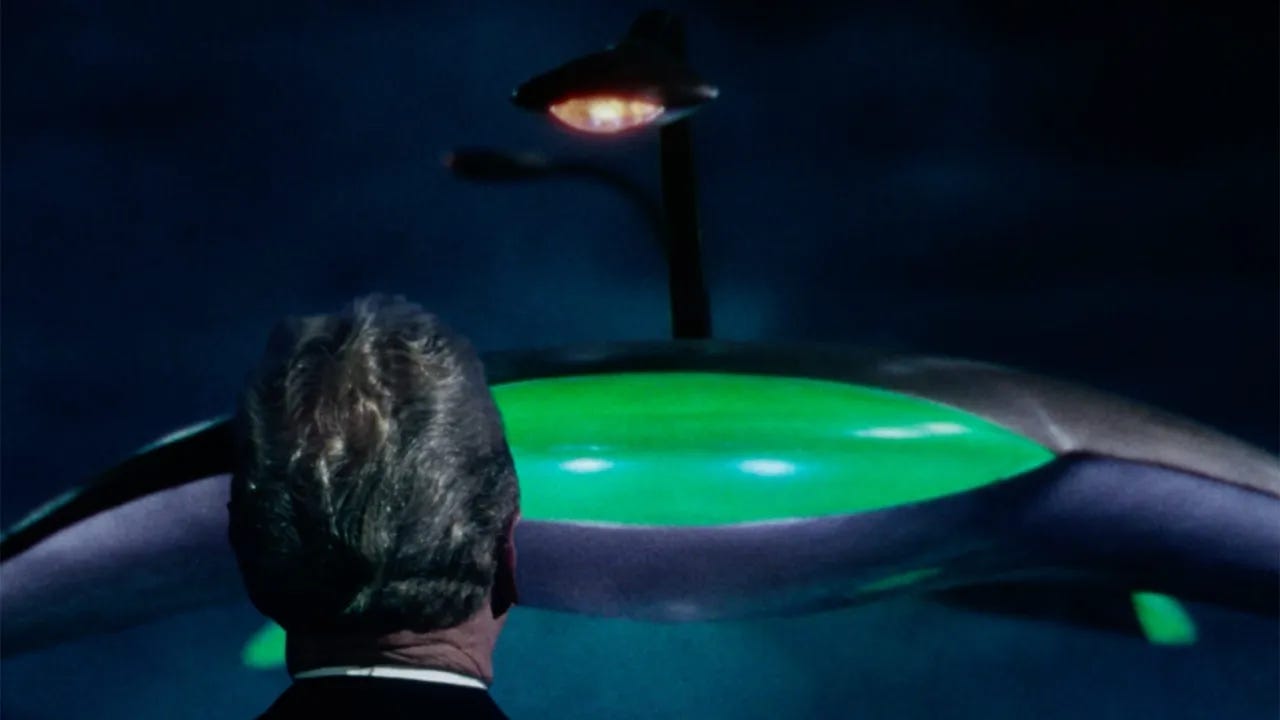
In the New York Times, Ruth Graham reported on a select group of pastors and podcasters who were recently chosen by a secret cabal to view ‘evidence’ of extra-terrestrial activity. Pastors being included among those preparing for possible UFO disclosure feels revealing in itself. It suggests this isn’t just being framed as a scientific or governmental issue, but as a human and existential one. Clergy are among the few people already practiced in helping communities navigate mystery, fear, transcendence, and questions about the unseen.
I was particularly struck by this section of the article, which noted how Russell Moore, of Christianity Today broached the subject during a recent adult Sunday school. According to the article,
Mr. Moore touched on the topic himself this spring in an adult Sunday school class at his evangelical church in Nashville. Teaching from the New Testament book of Hebrews, he discussed a passage in which the writer ponders humanity’s relationship to angels, and our lack of control over the universe around us. Mr. Moore opened the class by asking what it would mean to have some kind of direct contact with nonhuman creatures like angels — or extraterrestrials, lately in the news.
Afterward, “the conversations were less about aliens than they were about ‘What does it mean to be human?’” he recalled, adding that unidentified anomalous phenomena, colloquially known as unidentified flying objects, “weren’t the point for them, they wanted to talk about A.I.”
As the article suggests here, UFOs may not carry the same immediate existential weight for most people as something like AI. The latter is already shaping everyday life and forcing questions about consciousness, labor, creativity, identity, and what it means to be human. That conversation is already happening in the trench of ordinary experience.
UFOs still occupy a different space. For many people they remain suspended somewhere between speculation and Hollywood mythology. Even with growing plausibility, it feels like we haven’t fully crossed the threshold from cultural imagination into lived public reality. Maybe we’re not quite ready for that yet. Or maybe our more immediate and tangible crises are simply louder right now.
If disclosure ever comes in a way that feels undeniably real, the challenge may not be whether people can believe in UFOs. We’ve been imagining that possibility for decades. The challenge will be integrating that reality into everyday life while we’re already in the middle of reckoning with so many other destabilizing questions closer to home. And speaking of disclosure…